My Journey as an Executive Coach

From the archive of the previous website.
Ten years ago I felt like a gifted amateur in coaching.
I was preparing to leave the corporate world to work for myself. No big name behind me anymore. Just me, my instincts and the uncomfortable question of whether that was actually enough.
So I went back to university. Vrije Universiteit Amsterdam first, then Hult Ashridge Executive Education, London. I learned the theories, the frameworks, the research. But the most important thing I learned had no textbook.
I learned what to do with silence.
How to stay present when a leader sits across from you and doesn’t know how to say what needs to be said. How to resist the urge to fill the room. How real presence creates the safety for something true to emerge. And how in an intercultural setting, where silence means something different depending on where you’re from, that skill becomes the whole game.
Good preparation does something else too. It gives you stillness. When you truly know your craft, when the theory is in your bones and the reflection is a habit, you stop managing yourself and start being genuinely present. You can float above the moment. Trust yourself. Trust the silence.
That freedom doesn’t come from confidence. It comes from preparation.
In 2019 I got my Ashridge accreditation. Done, I thought. Then my peers sat me down. “Do the full Ashridge master. It’s life changing.” They were right. I ended up doing both: VU and Ashridge.
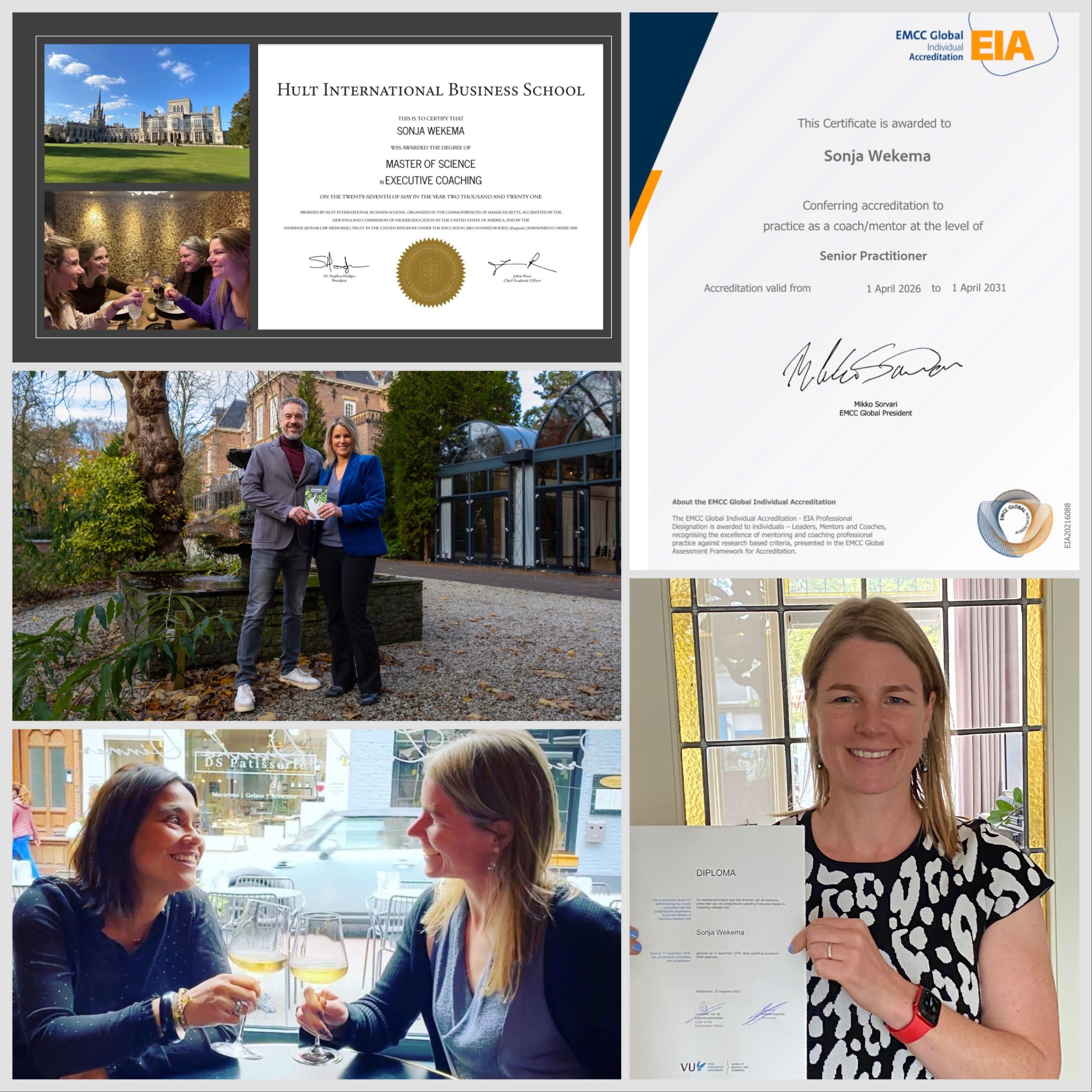
Along the way I met Dr. Matthias Schramm. Only once in person, in March 2020, just before the world shut down. The rest happened over Zoom. In 2024 our book Leading in a Wicked World came off the press. I also met Daphne Laan through the educational committee at VU. During COVID we decided to work on our research together and founded The Board Whisperers in 2021. I couldn’t have imagined any of this in 2016.
Earlier this month, my EMCC Senior Practitioner accreditation was renewed. The process reminded me about the importance of reflection: looking honestly at what happened; and reflexivity: asking what in you caused it. Your patterns. Your blind spots. The things you carry into the room without realising.
That practice lives everywhere. In the coaching room. In board advisory work. In leadership programmes across cultures, where what isn’t said matters as much as what is.
In a profession where anyone can call themselves a coach, that’s what separates people. Not the certificate. The work behind it.
Ten years in. Still learning. Nowhere near done. 🎉
Thanks to all my teachers, peers, colleagues, clients and my children – there is no better mirror 🪞